RTO, RPO and WRT Explained – Full Recovery Goes Beyond Systems Up
Many organizations believe their disaster recovery strategy is under control because they have defined RTO and RPO values — numbers that appear in backup reports, plans, and management presentations. On paper, everything looks organized. But there is a third metric that is almost always forgotten, and without it, most organizations are seriously underestimating how long recovery actually takes.
Let’s start with the basics.
RPO, or Recovery Point Objective, answers a simple question: How much data can we afford to lose? If your RPO is 4 hours, it means that in the worst-case scenario, you may lose up to 4 hours of data.
RTO, or Recovery Time Objective, answers another question: How long can systems be unavailable? If your RTO is 8 hours, it means the systems must be restored and technically running again within 8 hours after the incident.
Many people stop the discussion here, but this is where things become misleading.
Because when systems are back online, the business is usually not fully operational yet. Data may need to be validated, transactions may need to be re-entered, interfaces may need to be restarted, and users may need to verify that everything is working correctly. This is where Work Recovery Time (WRT) comes in.
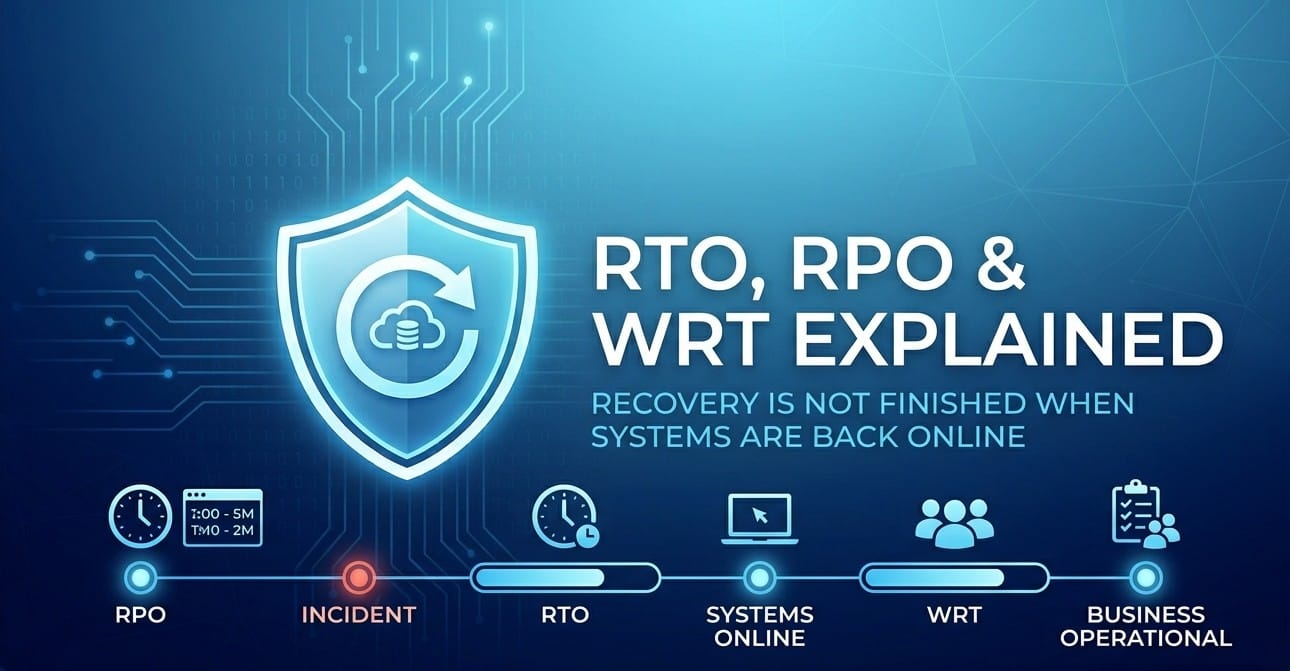
WRT is the time it takes for the business to return to normal operations after the systems have been restored. In other words: RTO is when IT is ready, WRT is when the business is ready.
This is an important distinction. You can meet your RTO target and still have the business unable to operate normally for hours or even days.
For example, imagine the following situation:
- Systems are restored within the 8-hour RTO.
- However, 6 hours of transactions were lost due to the RPO.
- Employees now need to manually re-enter orders, invoices, or production data.
- Data needs to be validated and reconciled across systems.
This also matters beyond operations. Regulations and standards around business continuity and ICT risk management don't just ask whether backups exist — they ask whether you can recover systems and resume business operations within acceptable timeframes. WRT is precisely what closes that gap between "systems up" and "business operational," and it's increasingly what auditors and regulators want to see demonstrated, not just documented.
In a solid cyber recovery and business continuity strategy, all three metrics must be understood together and tested regularly. RPO determines how much data you lose. RTO determines how long systems are down. WRT determines how long the business needs to fully recover — and that last one is almost always longer than anyone expects.
Recovery is not finished when systems are back online. Recovery is finished when the business is operating normally again.
In future posts, I’ll dive deeper into why recovery is often much harder than backup, and why cyber recovery is not the same as traditional disaster recovery.
Comments ()